Short answer: A PC item is an allowance in your contract for something you have not chosen yet. Tapware, tiles, a vanity, door hardware. The builder has to put a number somewhere to price the job, so they put in a reasonable allowance and the real number lands when you choose. So part of the price you signed was never a fixed number. It was a placeholder waiting on a decision from you. On a fixed-price contract, every change to a PC item comes back to you as a variation, every time. On cost-plus the actual cost flows through and the margin moves with it. On our jobs PC items cover the things you get to choose, not the things hidden in the ground. If you pick something dearer, it costs more. If it needs more work to install, that costs more too. If you pick something cheaper, we credit the difference back to you. And if a change costs no money but costs time, we still write it down as a variation, because your delivery date depends on it.
Your fixed price has moving parts in it, and they are named
This is the part that feels wrong until someone explains it.
You signed a price. Then you chose your tapware, and a variation turned up. Nothing went wrong and nobody is being sneaky. The item you just chose was an allowance, not a price.
The builder could not know what you would pick, so they put in a sensible figure and carried on pricing the rest of the job. When you pick, the allowance is replaced by what the thing actually costs, and on a fixed-price contract that difference has to be documented. That is what the variation is.
On a fixed-price contract, a change means a variation one hundred per cent of the time. On cost-plus it works differently: the real cost flows through and the margin moves with it, because the margin is a proportion of the cost. Which contract you are on decides what the change looks like on paper. We cover that choice in cost-plus and fixed-price contracts.
What we use PC items for, and what we do not
Ours cover the things you choose. Colours, brands, the look of a room, the fittings you will touch every day.
They are not there to cover what is under your block. Excavation and piering do not belong in a PC item, because those are not your decisions to make. Putting site risk into an allowance and calling it your selection would be the wrong way round.
Your thinking will change, and that is normal. Clients go and look at other houses, see something they prefer, and come back wanting it. We would rather build the house you want than the one you picked before you had seen anything.
There are three different deadlines, not one
This is where people get caught, because "choosing your finishes" is not a single decision with a single cut-off.
Anything the architectural plan carries has to be settled at design stage. If a PC item was drawn into the plan, changing it is not a shopping decision. It can change the plumbing, the excavation and the slab.
Anything needing support or a cable has to be settled between frame and rough-in. That is the deadline we cover in when to choose your finishes.
Colour and brand can wait the longest. If you want the same thing in a different finish, that is usually still open right up to ordering.
What a late change actually means on site
Here is one from a co-living build.
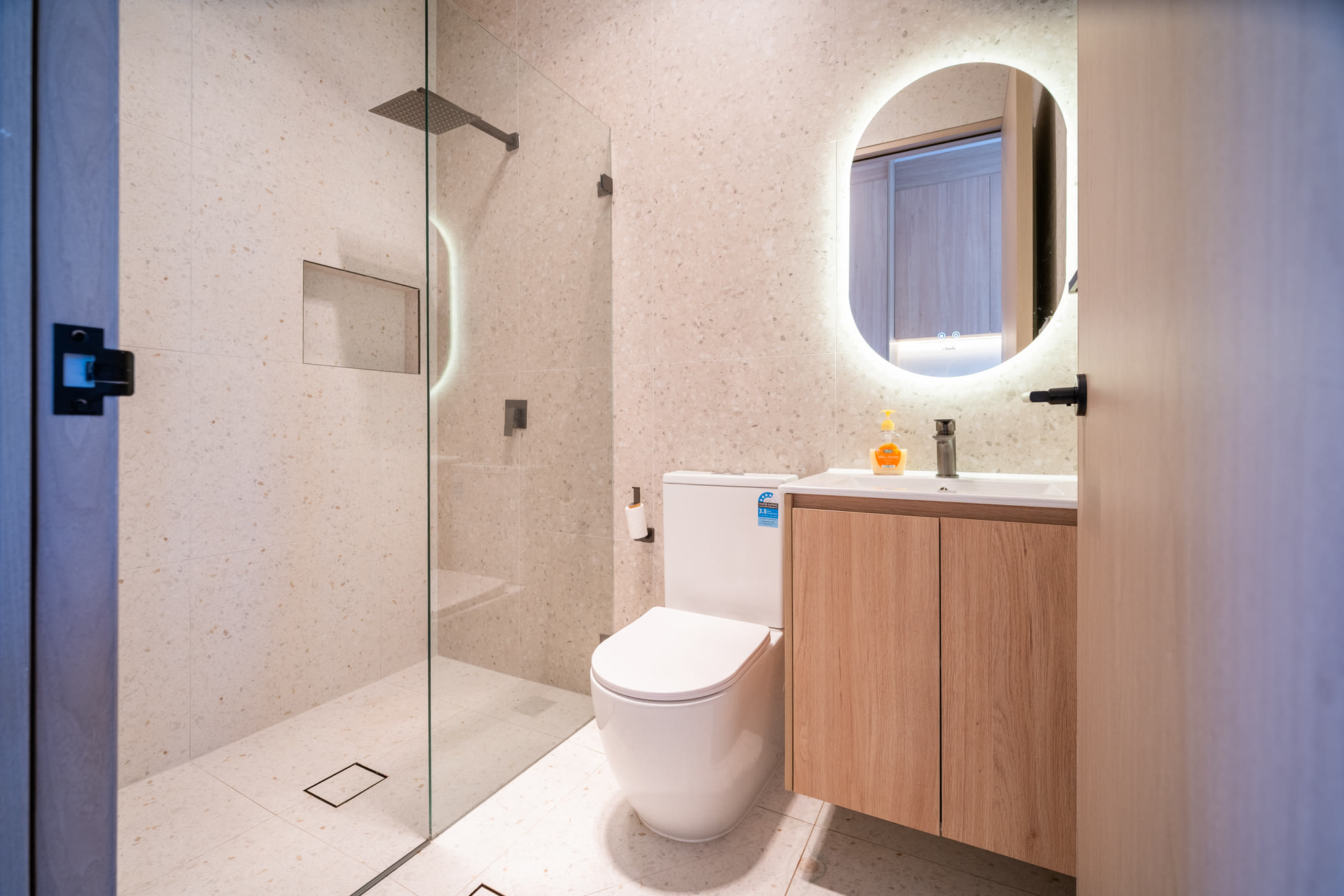
The bathroom vanity in the plan sat on the floor. Later, the client decided they wanted a wall-hung one instead. That is a small change to say out loud and a large one to build, because the plumbing set-out for a floor vanity is not the same as for a wall-hung one, and that set-out is in the slab.
It meant getting the plumbing team and the slab team working together to move the pipes. It was doable. It cost more.
Note that this is a different problem from the one in our finishes post. There, a wall-hung vanity needs timber behind the plasterboard to hang off. Here, it needs the pipes in a different place in the concrete. The same choice reaches back into two separate stages of the build, which is exactly why the earliest deadline is the one that matters.
What happens to the money
Straightforward, and worth asking any builder to confirm in the same terms:
- Pick something dearer than the allowance and the price goes up by the difference.
- If it takes more work to install, that costs more as well. A harder job is a harder job.
- On a cost-plus contract the margin moves with the cost, because it is a proportion of it.
- Pick something cheaper and we credit the difference back to you.
That fourth one is worth checking with whoever you build with. Not every builder passes a saving back.
Even a change that costs nothing gets written down
Not every change costs money. Plenty still cost time.
If you change your mind and a trade has to come back to redo something, that is a day on your program even when the invoice is nil. So we raise it as a variation anyway, with no money attached to it, and it goes on the record.
That is not paperwork for its own sake. Your build has a delivery date, and the only way that date stays honest is if everything that moved it is written down. A change nobody recorded is a week nobody can account for later. It is the same principle as what a fair variation looks like: you should know about it, and it should be on paper.
What to ask for before you sign
Ask for the PC items to be listed.
On our jobs they go into the proposal or the detailed tender, and we go through them sitting with you over the plan. That way you can see which parts of your price are real numbers and which parts are allowances waiting on a decision from you.
If a builder cannot show you that list, you do not know which parts of your price are actually fixed.
Questions we get asked
What is a PC item in a building contract?
It is an allowance for something you have not chosen yet, such as tapware, tiles or a vanity. The builder puts in a reasonable figure so the job can be priced, and the real cost replaces it once you choose. It is a placeholder, not a price.
Will I get a variation every time I change a PC item?
On a fixed-price contract, yes, one hundred per cent of the time. The allowance in your contract is replaced by what you actually chose, and that difference has to be documented. On a cost-plus contract it works differently: the real cost flows through and the margin moves with it. A variation appearing is the system working, not a builder being opportunistic.
Do I get money back if I choose something cheaper than the allowance?
On our jobs, yes, the difference is credited back to you. It is worth asking any builder this directly before you sign, because not every builder passes a saving back to the client.
Does changing my mind delay my build?
It can, and that is the cost people forget. If a trade has to come back to redo something, that is a day on the program even when no money changes hands. We raise it as a variation with no money attached so the delivery date stays honest, because a change nobody recorded is a week nobody can account for later.
This describes how we handle PC items on our own jobs. Every contract is written differently, so read your own and ask your builder to confirm in writing how allowances, credits and margin work on your build.
Want to see what is a real number and what is an allowance before you commit? Book a free feasibility session and we will go through it with you.
Book a Free Feasibility Session